Topics touched upon
ToggleCan AI be wrong?
AI tools are incredibly useful for everyday tasks such as answering questions, explaining topics, generating ideas and more however, beginners may discover AI misinformation. The response sounded perfect, detailed and confident, yet it’s clear, the information is not correct.
This often leads to the question: Can AI be wrong?
The short answer: Yes!
Understanding why AI gives wrong answers is important for anyone starting to use artificial intelligence tools regularly. In many cases, the issue is not that the technology is broken, but that AI works very differently from how many people assume.
5 Common reasons AI gives wrong answers
1. AI does not “think” like humans do
One of the biggest reasons behind why AI gives wrong answers is very simple: AI and humans do not “Think” in the same way. A person answering a question will use their understanding of the topic, rational reasoning, personal experience and own judgment to formulate their answer.
AI systems work differently.
Instead of thinking through a problem like a human, AI generates responses by identifying patterns in information it was trained on, such as books, articles, websites, research papers, and other written sources.
Rather than truly understanding information in the way a person does, AI uses those learned patterns to generate the response it believes best matches the question being asked.
A simple way to think about it is this: AI is an extremely advanced pattern recognition software, not an independent conscious thinking being.
This is why “Can AI be wrong?” is such an important question to consider when using the technology. An AI response may sound highly convincing because it is designed to produce natural, fluent language.
However, sounding confident does not mean the answer is correct.
2. Why the way questions are asked matters?
The way a question is asked can make a big difference to the answer AI gives.
If a request is too broad, unclear, or missing important information then the AI system has to make assumptions about what is actually being asked here. Those assumptions are not always correct and as a result often lead to AI misinformation.
For example, asking: “Help me plan dinner.”
Is extremely broad.
Does that mean a quick meal? A healthy dinner? Something vegetarian? A meal for one person? A family dinner? Something cheap?
AI does not automatically know which of these is intended unless that information is included.
Now compare that with the better AI prompt: “Help me plan a quick healthy dinner for a family of four using simple ingredients.”
It explains the type of meal required, who the meal is for, and allows the AI to provide suitable portion sizes for four people using only simple ingredients. Even small changes in wording can noticeably improve AI responses.
This is one of the common reasons why AI gives wrong answers, the issue here is simply that the first prompt did not provide enough information to the AI for family dinner for four people to be generated as a response.
Learning how to write better AI prompts is one of the easiest skills to develop to improve AI responses.
3. AI Hallucinations: When AI makes things up
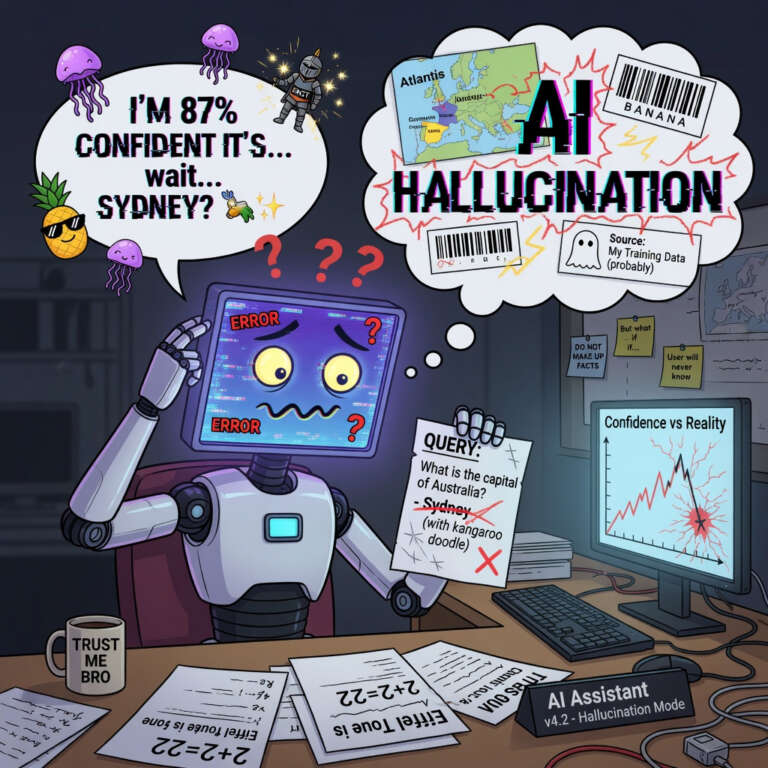
Another reason AI can produce incorrect answers is something known as AI hallucinations.
Despite the name, this does not mean AI is literally hallucinating in the human sense. The term is used to describe situations where AI generates information that sounds believable but are false, invented by the AI, or not supported by any statistic.
This might include:
– Made-up statistics
– Incorrect facts
– Fake references or sources
– Details that simply do not exist
For example, an AI tool might confidently provide a quote from a book that was never written, invent a statistic that cannot be verified, or reference a website that does not actually exist.
This happens because AI is designed to generate responses based on learned patterns rather than genuinely understanding whether information is true or false. When reliable information is not available, AI may still attempt to produce an answer that appears confidentially correct however certainly is not.
This is a prime example of why it’s important to ask the question “Can AI be wrong?”. Confident responses should not automatically be treated as correct. For factual claims always ask for a source and independently verify the information.
4. AI Misinformation: Why source checking matters
While AI hallucinations involve generating information that is completely invented, incorrect answers are not always caused this way. Sometimes, AI misinformation happens because the information artificial intelligent systems have learnt from was flawed or unreliable.
This is why source checking matters!
The internet is full of low-quality content, outdated articles, incorrect claims, misinformation, and content created without proper factchecking. AI systems are not always able to perfectly separate reliable information from poor-quality material. This is one of the main reasons why AI gives wrong answers. If inaccurate information exists in the material the system has learnt from, there’s a chance the mistakes appear in the responses.
Some topics are simply areas where AI should be treated with extra caution.
If an answer includes factual claims, especially around health, finance, legal topics, or current information, asking for sources and verifying those claims independently is a sensible habit to form.
5. AI Is not an expert in every topic
While useful for general knowledge, simple explanations, idea brainstorming and everyday tasks, that does not mean AI systems are experts in every subject. Most topics today still require specialist knowledge to understand at a higher level and from time-to-time artificial intelligence systems aren’t as up to date with information to reliably handle requests on those topics.
For example, general cooking advice or help writing an email are requests handled well, while highly specific legal questions, medical guidance, tax rules, or technical industry advice can be far more difficult. That’s where qualified professionals such as lawyers, doctors, accountants, or IT specialists are essential.
Small mistakes in risky areas can have serious consequences and understanding the limitations of AI is vital for high-risk industries looking to take advantage of the technology.
How to reduce wrong AI answers
Although incorrect answers can happen, there are simple ways to reduce the chances of poor AI responses.
Good habits include:
- asking clear and specific questions
- providing enough detail and context
- requesting sources for factual claims
- verifying important information independently
- asking follow-up questions if something seems unclear
- avoiding blind trust in confident-sounding answers
Learning how to use AI effectively is not about expecting perfection. It is about understanding how the technology works, where its limitations are, and how to use it more intelligently.
AI can be incredibly useful when used appropriately, but like any tool, it works best when its strengths and weaknesses are properly understood.
Final thoughts
AI is not perfect, but that does not mean it is not useful. Understanding where AI performs well, where it struggles, and why mistakes happen helps build better habits and makes AI a far more valuable tool in everyday use.