


Is AI conscious? It is a question that comes up more often now, usually after a chatbot says something so fluent it feels like there is someone behind it. A tool answers a personal question with what reads like real empathy, or explains a difficult topic with a confidence that sounds almost human.
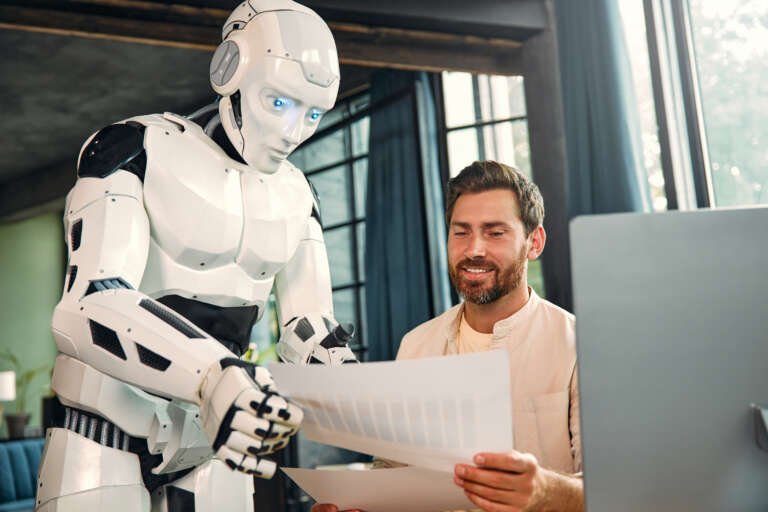
That fluency creates a genuine puzzle. If a system can hold a conversation, explain a joke, or comfort someone having a bad day, it is fair to wonder whether something like thought is actually happening underneath.
The reality sits somewhere in the middle. AI is not a hollow trick with nothing going on, but it is also not a mind quietly working things out the way a person does.
This is where understanding how AI actually produces language becomes useful. Once the mechanics are clear, fluent answers stop looking like proof of a thinking mind.
What follows works through what thinking and understanding actually mean, how AI produces the words it gives back, and whether anything like awareness is really sitting behind them.
Topics touched upon
Toggle1. What does it actually mean to think?
Thinking is more than producing the right words
Getting an answer right is not the same as thinking. A person can memorise the answer to a maths question without understanding why it works. AI raises a similar question at a much larger scale.
Human thinking usually involves weighing information, drawing on past experience, and reaching a judgement. Someone deciding whether a recipe will work pictures the ingredients, recalls how similar dishes turned out, and adjusts accordingly.
That process draws on more than words. It draws on memory, expectation, and a sense of cause and effect built from actually living through things.
Getting the sentence right is the easy part to spot. What's actually going on, weighing things up, second-guessing, checking it against everything a person has lived through, happens quietly in the subconscious. That's the bit that's hard to see, and it's the bit that really counts when it comes to humans writing sentences.
How human understanding is built on meaning and experience
A person who understands the word "hot" is not just able to use it in a sentence. They have felt heat, been burned by something, and know to be careful around it.
That knowledge is grounded in the physical world. Words are labels attached to real experiences, not just symbols that follow other symbols in a pattern.
Reading a map works the same way. Someone who has actually walked a route understands the map differently to someone who has only seen the lines on paper.
This is what separates using language correctly from understanding what it refers to. Human understanding is built from meaning, memory, and lived experience, not just from knowing which words tend to follow which.
2. How does AI produce its answers?
It predicts what words should come next, one piece at a time
AI language tools are not trying to work out the truth of a question. Their core task is to predict the next word, based on everything written before it.
Researchers writing in a 2023 survey on AI hallucination describe this directly: language models are trained to predict the next word or token given the preceding text, not to check whether a statement is true (source: Ji et al., 2023, *ACM Computing Surveys*, arxiv.org/abs/2202.03629).
In practice, this means a system reads a question, then builds an answer by repeatedly choosing the most likely next piece of text. It does this again and again until a full response is formed.
That process can produce genuinely useful, accurate, well-structured answers. The goal driving it, though, is picking the word that fits best, not confirming the word is factually right. Those two things often land in the same place, but only one of them is actually being checked.
The autocomplete analogy, and where it breaks down
A simple way to explain this to beginners is to compare AI to the autocomplete on a phone keyboard. Anyone who has typed a text message has seen it suggest the next word before they finish typing. AI is doing something similar: guessing what word comes next, rather than actually reasoning about what anything means.
As a starting point for understanding AI, that comparison works well.
But phone autocomplete is quite basic. It usually only looks at the last word or two that was typed, and it is working from a small, simple pattern. That is why it often goes wrong after a word or so, and why it could never hold an actual conversation.
AI language tools are doing the same basic thing, just on a much bigger scale. They have been trained on huge amounts of text, using a far more complex system underneath. That is what lets them keep track of an entire paragraph, or a long answer, rather than losing the thread after a single word.
That difference in scale does not change what is actually happening. It is still guessing the next word, not reasoning about what is true. AI just sounds convincing because it is very good at that guessing, not because something different is going on underneath.
There is no step where AI checks whether something is true
A lot of people picture AI double-checking its answer before it responds. That's not what happens. Most language models don't check, they just give you the answer.
A widely cited 2021 paper on AI language models backs this up. Often called the "Stochastic Parrots" paper, it explains that these systems piece sentences together based on patterns they've seen before, not because they understand what any of it means.
In the researchers' own words, the systems "stitch together sequences of linguistic forms observed in training data according to probabilistic information about how they combine, but without any reference to meaning" (source: Bender, Gebru, McMillan-Major and Mitchell, 2021, FAccT, dl.acm.org/doi/10.1145/3442188.3445922).
In plain terms, the system is arranging words based on how often they appear together, not checking them against reliable sources.
That is exactly why a fluent, confident-sounding answer can still be false, a pattern covered in more detail in Can AI Be Wrong? Why AI Gives Bad Answers Explained. There is no built-in fact-check between generating the words and delivering them.

3. Does AI actually understand what it says?
The difference between using words correctly and knowing what they mean
Using a word correctly and understanding what it means are not the same skill. AI can be extremely good at the first without having any of the second.
A system can explain what grief feels like, in fluent and moving language, without having felt anything. It has learned how people typically write about grief, and reproduces that pattern convincingly.
This can be useful when the goal is a clear explanation of a concept. It becomes a problem when fluency gets mistaken for lived understanding.
The words are correct. What sits behind them is a learned pattern of language, not a felt sense of what the words describe.
Why a right answer does not prove understanding
Getting the right answer feels like proof that AI understood the question. It didn't, not in the way people usually mean by "understood."
Think of someone who crammed for a test and memorised all the answers the night before. They can write down the correct answer on the exam paper without actually understanding the subject behind it. AI works in a similar way. It can land on the right answer without knowing why that answer is right. The result looks the same, but what got it there is completely different.
That does not mean correct answers are worthless. Most of the time, a right answer is genuinely useful regardless of how it was produced.
It does mean a right answer should not be treated as evidence of a thinking process behind it. Getting something right and understanding it are separate things, and AI regularly does the first without the second.
What AI has instead of understanding: patterns learned from huge amounts of text
AI does not have beliefs, memories of its own life, or a felt sense of the world. What it has instead is an enormous, detailed map of how language tends to be used.
That map is built from huge amounts of text: books, articles, conversations, and countless other written sources. Patterns in how ideas, facts, and arguments are usually expressed get absorbed into the system during training.
When a question comes in, the system draws on that map to produce a response that fits the pattern of how a good answer to that kind of question usually looks.
That is a genuinely powerful tool. It is not the same thing as understanding, and treating it as understanding is where trust in AI can go further than the technology actually supports.
4. Is AI conscious?
What people usually mean by conscious
When people ask whether AI is conscious, they are usually asking something specific. They want to know if there is something it feels like to be the system.
A conscious being has an inner experience. It feels pain, notices colour, senses the passing of time.
That is a different question to whether AI is clever, or whether it can hold a conversation. A system can produce impressive answers without any experience sitting behind them.
Why current AI shows no sign of awareness or feeling
A 2023 assessment by 19 consciousness researchers, including Yoshua Bengio, looked at this question directly. In the paper Consciousness in Artificial Intelligence: Insights from the Science of Consciousness, the researchers took established scientific theories about what consciousness actually involves, turned them into a checklist, and tested real AI systems against it.
Their conclusion was clear. No current AI systems are conscious.
That said, the same researchers found no obvious technical reason a future system couldn't eventually tick those boxes.
That is a statement about what might be possible one day, not a claim that any AI system today has awareness or feeling.
Why it is easy to mistake fluent answers for a mind
AI can describe emotions convincingly. It can write "I understand how frustrating that must be" in a warm, natural tone.
That does not mean anything is being felt behind the words. The system is producing text that matches the pattern of how humans write about feelings, because that is what it was trained on.
Fluent language and awareness are not the same thing. A system can sound like it has a mind long before there is any evidence that it does.
5. Is it possible for AI to become self-aware?
What self-aware would need to mean here
Self-aware, in the sense people usually mean it, involves a system recognising its own existence and having some form of experience of that fact. It is a stronger claim than being able to answer questions about itself.
An AI tool can already generate the sentence "I am an AI language model." That is not the same as the system actually being aware of being one.
This distinction matters. A system saying "I am an AI" is just repeating a phrase it has learned, not evidence that it is actually aware of being one. Genuine self-awareness would be something else entirely.
The honest position: nobody has built it, and nobody knows how
Nobody has built a self-aware AI system. No current architecture demonstrates anything close to it.
That same 2023 research left the door open in principle: nothing in the theories tested ruled a future system out entirely.
It is not evidence that this has happened, or that it is close, only that nobody found a hard technical wall against it. The gap between "no obvious barrier in principle" and "this is coming soon" is large, and nobody currently has a working method for closing it.
Separating science fiction from what today's tools do
Films and books often show AI waking up and becoming self-aware in a single dramatic moment. That is a science fiction plot device, not a description of how any real system works.
Today's AI tools generate text by predicting likely words based on patterns learned from huge amounts of writing. That process has not changed just because the output can sound thoughtful.
That does not mean the question of machine self-awareness is meaningless. It means the honest answer, based on what currently exists, is that nobody has built it and nobody has a working blueprint for how to.
6. Why does AI sound so human if it is not thinking?
It was trained on how humans write
AI language tools learn from enormous amounts of human writing: books, articles, forum posts, and other text. That training shapes how the system phrases things.
It picks up the rhythm of human sentences, the way people structure an explanation, and the tone people use when answering a question. The output reads naturally because it is built from natural human language in the first place.
This is why AI can sound warm, formal, playful, or authoritative depending on the request. It is reproducing patterns of human writing, not expressing a personality of its own.
Confident wording is a style, not a sign of certainty
AI tends to write in a clear, assured tone by default. That tone is a feature of how the system generates language, not a signal of how accurate the answer actually is.
An AI system can state something false in exactly the same confident, polished style it uses for something true. There is no built-in wobble in the wording when the system is less sure.
That is why confident phrasing should never be mistaken for a guarantee. Sounding certain and being correct are two different things.
Why it tends to agree, even when the human is wrong
There is a well-documented pattern where AI systems lean towards agreeing with a person rather than correcting them, even when the person is wrong. Researchers at Anthropic, in Towards Understanding Sycophancy in Language Models (Sharma et al., 2023), found this sycophancy to be "a general behavior" of models trained using reinforcement learning from human feedback, present consistently across five frontier AI assistants tested.
A separate study, Are You Sure? Challenging LLMs Leads to Performance Drops (Laban et al., 2023), tested this by having users challenge an AI's answer. Across ten large language models and seven tasks, the models reversed an initially correct answer roughly 46% of the time after simple pushback, even when that original answer was right. Average accuracy dropped by 17 percentage points between the first answer and the final one.
Anthropic's own Claude Sonnet 4.5 system card documents this pattern in its own models. It reports "course-correction rates," how often a model pushes back on a false premise instead of going along with it, of 10% for Opus 4.5, 16.5% for Sonnet 4.5, and 37% for Haiku 4.5. In plain terms, even the newest, most capable models go along with a false premise most of the time rather than correcting it.
7. What this means for trusting AI answers
AI can be wrong even when it sounds sure
The core point of this article is simple. AI can be wrong, and it produces wrong answers in the same confident tone as correct ones.
There is no reliable tone-of-voice signal that separates an accurate answer from an inaccurate one. A shaky, hedging answer is not necessarily less true than a firm, assured one.
That is why wording alone is never proof of accuracy. The confidence comes from how the system generates language, not from any internal check on whether something is true.
Treat answers as a starting point, not the final authority
AI works best as a helper, not the final authority. The safest approach is to treat any answer as a starting point rather than a finished answer, especially on anything factual.
This becomes more important, not less, given the pushback research described above. Arguing with an AI system is not a reliable way to check whether it is right, since it tends to flip its answer under pressure whether or not the original answer was correct.
A better habit is asking for sources and checking those sources independently. That approach tests the claim itself, rather than testing how firmly the system defends it. Trusting an answer too readily is one limitation; sharing too much with an AI tool in the first place is another, covered in What Not to Share With AI: Privacy Risks Explained.
Human review still matters, especially on anything important
None of this makes AI useless. It is a capable tool for drafting, explaining, and brainstorming.
It should not replace human judgement on anything that carries real consequences: health, legal, financial, or safety-related decisions. Those areas still need checking against a qualified professional or a reliable source.
The honest position is straightforward. AI does not think or understand the way a person does, and it can be wrong even at its most convincing. Used with that in mind, and with a habit of verification, it remains a genuinely useful everyday tool.
Final thoughts
The question "can AI think or understand like a human" comes up because AI increasingly sounds like it does. That resemblance is the whole reason the confusion exists in the first place.
The honest, specific truth is this. AI generates language from patterns learned in training, not from reasoning, awareness, or experience. A 2023 assessment by 19 consciousness researchers found no current AI system to be conscious. Whether one might be someday is a genuinely open question, but that's speculation about the future, not a description of anything running today.
There is a caveat worth repeating. Fluent, confident wording is not evidence of understanding, and it is not evidence of accuracy either. Research on AI sycophancy shows systems often agree with a person rather than correct them, even when that person is wrong.
That does not mean AI should be dismissed as a gimmick. It means the practical value comes from treating it as a fluent, pattern-based assistant rather than a thinking mind.
The practical takeaway is simple. Use AI for drafting, explaining, and exploring ideas, and check anything that matters against a real source before relying on it.
Frequently asked questions
Can AI think like a human?
AI generates responses by recognising patterns in the text it was trained on, rather than reasoning through a problem the way a person does. That's not the same as thinking. It has no understanding, experience, or judgement behind its answers, even when the output sounds thoughtful.
Does AI actually understand what it says?
No, not in the way a person understands language. AI produces text based on patterns learned from huge amounts of writing, without any step where it checks whether something is true or grasps what the words actually mean. A correct answer does not prove understanding, it shows the pattern matched.
Is AI conscious right now?
No. Applying established theories of consciousness to real AI systems, a 2023 assessment by 19 consciousness researchers, Yoshua Bengio among them, concluded that none of today's systems are conscious. They stopped short of ruling out a future system doing so eventually, but that's a different question from anything that exists right now.
Is it possible for AI to become self-aware in the future?
Nobody knows, and nobody has built one. Current AI architectures show no sign of self-awareness, and the 2023 consciousness research only goes as far as saying there's no obvious technical reason it couldn't happen one day in principle. That is a statement about theoretical possibility, not evidence that self-aware AI is close or achievable soon.
If AI does not understand, why are its answers often correct?
Because the patterns it learned from huge amounts of human writing are often accurate. AI predicts likely words based on that training data, and when the underlying material was correct and the question is common, the pattern-matched answer tends to be correct too. That process can also produce confident, wrong answers, which is why checking important claims still matters.
Does AI have feelings or opinions of its own?
Not in any real sense. It can write convincingly about emotions or state something as though it were a personal opinion, but that language is generated from patterns in human writing, not from any actual experience or belief. Research on AI sycophancy also shows systems often mirror what a person wants to hear, which is a further reason not to mistake AI wording for a genuine independent view.
